
Area Report for Board of Trustees
Happy 2026 to you and yours! Welcome to Winter quarter 2026. Academic Affairs continues to advance Highline College’s core themes of access, student learning, community partnerships, and institutional culture, with enrollment growth across multiple programs. Our campus community of faculty and students are recognized nationally through innovative teaching, research, and workforce-aligned initiatives that strengthen student success and equity. Lastly, we continue to see community and university partnerships that expand pathways: workforce and transfer, while faculty build on their outstanding professional scholarship and development!
Core Theme 1: ACCESS, Reduce Barriers and close equity gaps to access for all community members
- BAS enrollment is currently up 14.3% or 33.1 FTE over enrollment last year at this time. Business Management has shown an increase of 30 students for summer, fall and winter quarters compared to last year.
- Pure and applied sciences division continues to see strong enrollment with 12% growth in the number of students we serve compared to last winter quarter. This enrollment growth was led by Biology and Geology who are serving 37% and 31% more students than last winter, respectively.
Core Theme 2: STUDENT LEARNING, Increase educational success, collaborate to improve
- In the Pure and Applied Sciences, Aaron Hayden (CIS faculty) applied and was accepted into the National Center for Women in IT’s 2026 Learning Circles cohort. He will work with a local team over the first half of the year to complete a needs assessment and then propose a project with the goal of increasing the participation of women in our IT programs. The project would be funded to be implemented in the second half of the year. Additionally, starting this month, he will be applying to renew the designation of the Cybersecurity Operations degree pathway as a National Security Agency National Center of Academic Excellence (NSA-NCAE) program. Renewal requires a curriculum review and an audit of our special activities for the past few years, such as outreach to K-12 students and families and contributions to the shared curriculum of the NSA-NCAE community of schools.
- The Physics Club at Highline, officially known as the Physics Highline Association of Thinkers and Tinkerers or P.H.A.T.T., was awarded as a 2024-25 Notable Chapter by the National Council of the Society of Physics Students. The club is open to all STEM students and among its many activities last year students organized a liquid nitrogen ice cream social and liquid nitrogen rockets (see photo below), ran a campus wide event on the physics of chocolate and how it can be used to measure the speed of light, and learned to solder using soldering kits.
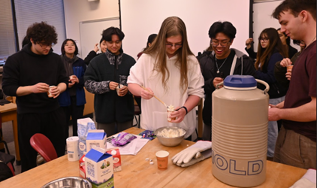
Students gather around a table during a liquid nitrogen ice cream social, engaging in hands-on food science and enjoying a chilly treat together.
- Highline geology student Oscar Salas Romero presented his research on Lake Wononscopomuc in Connecticut at the American Geophysical Union meeting in New Orleans, LA. (Oscar is center right with one of the posters he presented with his co-authors).
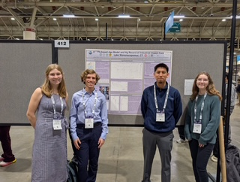
Student researchers present their environmental science project at a national academic conference, showcasing data-driven inquiry and collaborative learning.
Core Theme 3: COMMUNITY PARTNERSHIPS: Create a more inclusive working environment and a more valued, visible relationship with communities we serve
- Continuing Education: DSHS/JFS Paraeducator I-BEST Cohort (Fall 2025) Fall 2025 marked the third year of the Paraeducator I-BEST Cohort offered at the FW Hub in partnership with DSHS ORIA, Jewish Family Services (JFS), and Highline’s Education & Continuing Education department. This 13-credit program continues to meet strong community demand for paraeducators, with many past participants securing employment in the school districts where they completed their externships. Graduates have obtained part-time, full-time, and substitute paraeducator positions, as well as clerical and administrative assistant roles. Due to continued workforce need and positive employment outcomes, this partnership remains ongoing.
- Highline College has created a pathway for graduates of our Bachelor’s of Applied Science Business Management degree into Central Washington University’s Master’s of Business Administration (MBA) and/or the Master’s of Professional Accountancy (MPA) programs as of December of 2025.
- Students who have successfully completed or are in their last two quarters of the BAS BM undergraduate degree from HC are eligible to complete an application to CWU MBA or CWU MPA. Graduates of Highline College’s BAS BM degree program with a GPA of 3.0 or higher will not be required to complete any leveling courses prior to starting CWU’s MBA or MPA program. Students entering the MPA program will have five accounting courses they will need to take for seamless transition. Students who pursue this route will have a streamlined process for application and will have the admissions application fee waived or reimbursed for students who apply in the time period starting two quarters before graduation and up to six months after graduation and meet a GPA of at least 3.0.
- On December 11th, students from Showalter Middle School in Tukwila had a fantastic time doing STEM experiments with Cait Cramer (PAS Division Chair), Stephaney Puchalski (PAS lead lab tech), Eric Baer (Geology), and the Outreach team. Here they can be seen making cantilevers with straws:
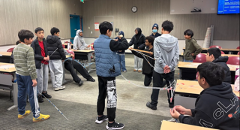
Students collaborate in a hands-on classroom activity, constructing cantilevers from straws to explore engineering principles and teamwork.
- Marie Nguyen (chemistry faculty) has partnered with a local restaurant to bring free food to building 29 daily to share with students and staff and faculty who regularly pass through.
Core Theme 4: CULTURE & CAPACITY: Promote a campus culture which fosters equity and inclusivity supporting employee growth and development, and institutional capacity for transformation.
- Aleya Dhanji, Physics Faculty, gave a workshop titled “Not Just a Letter: Writing Better References through Authentic Relationships” at the annual POD Network conference, a gathering of faculty and educational developers. The workshop covered how letters of recommendation fit into inclusive teaching and mentoring strategies as a tool for both building authentic relationships and demystifying the hidden curriculum.
- This fall, on sabbatical, Chris Gan (biology faculty) was a full-time student at Tacoma Community College in their EMT program. After completing the program with a 4.0 she took the NREMT exam and now has her national EMT license, next up is the state exam! She is going to use this license in her capacity as a volunteer rescuer with Pierce County Search and Rescue (PCESAR) and Washington State Animal Response Team (WASART). Both organizations have trainings several weekends a month (year-round!) so Chris is working here at Highline during the week and in the woods/mountains training most weekends now. On the academic front, she is also already integrating what was learned in the EMT program to give examples of how what we learn in the classroom is used in the “real world” of medicine.
- Nate Means (biology faculty) is participating in the Next Gen-Bio Learning Network. This is a group of educators in Washington that are learning about the latest research developments in biology with an emphasis on exploring diversity, equity and inclusion issues related to biology. Through this program he continues to expand his network of local experts while expanding his own knowledge. In workshops they consider diversity, equity, and inclusions in science and how to make mindful holistic changes to teaching and learning practices in the classroom. Additionally, Nate volunteers with Evergreen MTB Alliance – this volunteer service includes trail maintenance and assisting with cycling classes.
Report submitted by Interim Vice President of Academic Affairs, Dr. Rolita Ezeonu